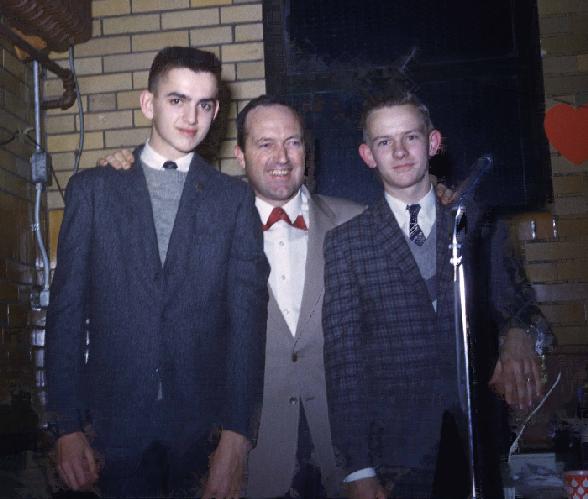
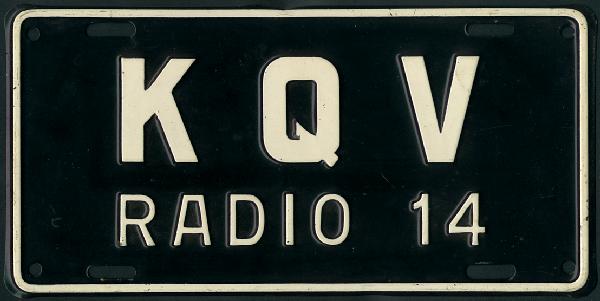

| Former KQV Engineer Paul J. Carlson of Ross Township passed away on Friday January 29, 2010 at the age of 67. The late Paul Carlson was one of the first contributors to the KQV Website. From license plates to business cards, early station playlists, jingles, airchecks and many other items. Thanks for all of your wonderful additions to this website. |
| How
I Learned About Shtick! (from Paul Carlson)
In 1963, KQV had been a Top Forty format station for five years, but significant portions of the day were still devoted to legacy programs. The station's owner, American Broadcasting, required some programs to be carried, like John Cameron Swayze and Edward P. Morgan and Paul Harvey. These programs did not fit the Top 40 format at all, and chased listeners away in droves. Worse yet, the programs did not pull in significant new audience during their period. They were in short an albatross around the figurative neck of the station. KQV scheduled these programs to run between 6:30 and 7:15 pm each day, and called the period News Scope. Just before the network portion of News Scope started, KQV also carried a local legacy program, The Pie Traynor sports report. Pie had been reporting sports on KQV for years before ABC bought the station, and his was the only local program that ABC retained as they reshaped the format. Pie was a sweet old guy. A pleasure to work with, never cross, never demanding, and he knew the sports beat without a doubt. He had been a Pittsburgh Pirate player in the 1920's and 1930's, and was often called the finest third baseman ever to play for the Pirates. He had one failing though, which was his delivery. He had a raspy voice that was hard to listen to, and aggravated the voice with very frequent umm's, aah's and other hems and haws. It seemed that every tenth syllable was extra baggage. I had been a listener to KQV for years, and always had turned off the radio when Pie Traynor came on because I found him so hard to listen to. Besides, I had no sense of history, and though I knew some of his past accomplishments, I wasn't very impressed. In short, I didn't care to listen to his broadcast. Late in 1963, I had a temporary job engineering at the studio and, as chance would have it, my shift sometimes overlapped Pie's, so I was the engineer who was charged with making him sound good. One December night, I got my chance to help. Pie came in early and recorded his program so he could make a conflicting date at an awards dinner. Presently, there I was, staring at a reel of tape holding a broadcast that would not be needed for an hour, and in my hand was a sharp razor and a roll of splicing tape. It was like living a dream. Without even making a safety dub, I attacked the program tape with my splicing gear, and in half an hour had excised every hem and every haw, making Pie Traynor sound like the legendary DJ, Speedy Clip. Well, maybe not Speedy Clip, but he sounded 100 percent better to my ear. I cued the tape, and when 5:25 came around, I rolled it. Keeve Berman was doing the announcing for News Scope that night, and he listened to Pie without comment, then introduced the next program, probably Paul Harvey, but I don't remember for sure. I had expected a comment from Keeve about the unusual glibness in Pie's report, but none came, so I asked Keeve what he thought of the program. I don't remember exactly what words were exchanged, but I sure remember the gist of it: me:
Didn't Pie sound good tonight?
He was right, of course. Pie never said anything about the show. I doubt that he knew. But I never again felt tempted to clean up a Pie Traynor broadcast, or interfere with any on air personality. My job was to make sure the equipment ran right, and the artistry belonged to the artists. Most engineers, myself included, don't know schtick. |
| KQV 1960 Sign-Off # 1
(including Chuck Dougherty, Henry DaBecco, Dave Scott, Lee Vogel, Roy Elwell, Jim McLaughlin) |
 |
| KQV 1960 Sign-Off # 2
(including Chuck Dougherty, Henry DaBecco, Dave Scott, Lee Vogel, Roy Elwell, Larry Aiken) |
|
| KQV 1960 Lee Vogel End
of Show
(next to last KQV show) |
|
| KQV 1960 Sam Holman Open
(Dick Drury filling in for Sam) |
|
| KQV 1960 Rod Roddy Open |
|
| KQV 1960 Station Promos
(Henry DaBecco, Dave Scott, Roy Elwell, Chuck Dougherty, Jim McLaughlin, Lee Vogel) |
|
| KQV 1960 Top 40 Show Open & Close |
|
|
Jolly Jim McLaughlin KQV Aircheck October 10, 1960 pt 2
Note the diversity of the songs played here: 'The Twist' - Chubby Checker 'Pineapple Princess' - Annette 'Sleep' - Little Willie John 'Green Leaves of Summer' - Brothers 4 - Wax to Watch 'Everyday' - Bobby Vee - from Album of the Week 'Stay' - Maurice Williams - # 1 Song of the Week Aircheck opens with Bill Owens - ABC News and Rod Roddy
Roy Elwell's September 6, 1959 Sunday Night Show pre-taped It was Roy's last show on KQV before leaving for Pasadena. Bill Jennings was the newsman and also did the KQV Weatherscope. Rod Roddy KQV Aircheck Sept 5, 1960
Rod Roddy hosting a special Oldies Weekend spot-lighting the Fifties Lou Janis KQV Aircheck Sept 6, 1960
Lou Janis of WMCK in McKeesport did part time weekend overnight work on KQV Dick Drury for Rod Roddy KQV Aircheck November 29, 1960
In late November of 1960, Rod Roddy disappeared. KQV Program Director Dick Drury filled in. On this Aircheck Drury explains Roddy's absence. The Pittsburgh Post Gazette's Arnold Zeitlin explains.
KQV Action Central News
This is the sound of KQV's Action Central News 1962 KQV News Scope 1964
1964 KQV News Scope intros with Keeve Berman Dave Scott Close, Bill Jennings Id, Larry Aiken Opening December 13, 1959
Larry Aiken Opener was voiced by Chuck Daugherty Don Howard Aircheck 9/23/63
Don Howard is actually Bob Connors from WEEP. Henry DaBecco Show Opener August 23, 1962
KQV Exclusive Announcement
Voiced by Dave Scott 1963 KQV Pulse Beat News
Rod Roddy Show Opener March 31, 1961
This was Rod Roddy's Show Opener on his final Evening Show
KQV Wax To Watch & Number 1 Skits 1958 or 1959
Produced by KQV's Raggedy Pants Players
|